
Stratego rules
Hide 40 pieces, move one per turn, Red first. Higher rank wins each fight. Capture the enemy Flag to win.
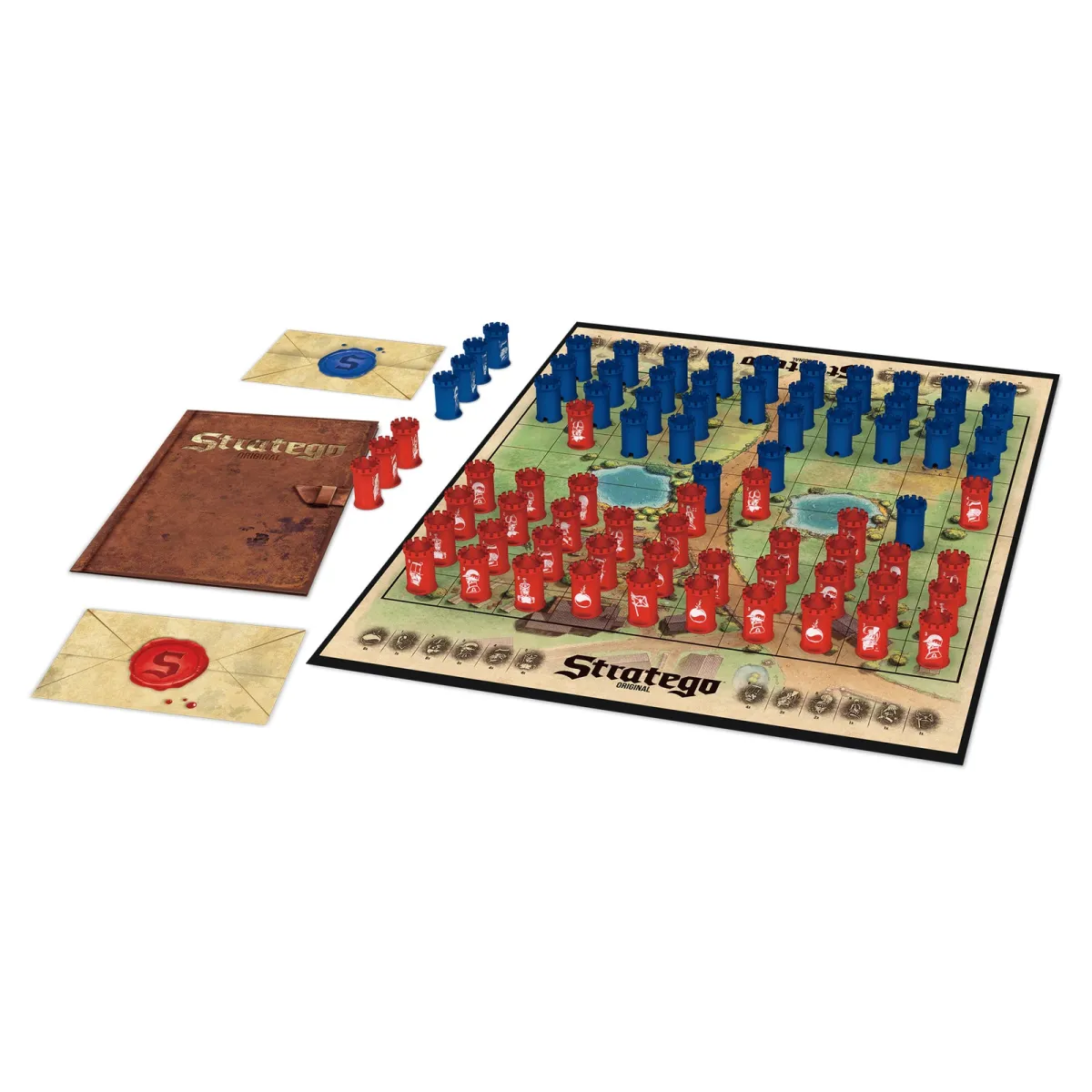
Contents
The goal of the game
Capture your opponent's Flag. You also win if your opponent cannot move or attack on their turn: the official Jumbo rulebook says that player must surrender.
Board and pieces
- The board is 10 squares by 10 squares.
- Two lakes of 2×2 squares sit in the middle two rows. No piece may enter or cross them.
- Each side has 40 pieces: 33 that move and 7 that never move (6 Bombs and the Flag).
- Ranks are printed on one side only, so you see your own pieces and only the backs of your opponent's.
The full list with counts and powers is on the piece ranks page.
Setting up
Each player places all 40 pieces in the four rows nearest to them, one piece per square, ranks facing themselves. The two middle rows with the lakes stay empty. You choose every position, so the setup is part of your strategy; see our setup guide.
Taking turns
Red moves first, then players alternate. On your turn you must either move one piece or attack with one piece. You cannot pass.
How pieces move
- Pieces move one square forward, backward, left or right. Never diagonally.
- A piece cannot move onto a square held by its own side, jump over pieces, or enter a lake.
- Bombs and the Flag never move once placed.
- Two-square rule: you may not move the same piece back and forth between the same two squares more than 3 times in a row.
The Scout's special move
The Scout (rank 2) moves any number of empty squares in a straight line, like a rook in chess. It cannot jump over pieces or lakes. Under the current rules it may move several squares and attack at the end of the same move. Moving more than one square tells your opponent the piece is a Scout.
Attacking
Move a piece onto a square held by an enemy piece to attack it. Both pieces are revealed. Then:
- The higher rank wins and the lower piece is removed. If the attacker wins, it takes the empty square; if the defender wins, it stays put.
- Equal ranks: both pieces are removed.
- Attacking is never forced. Pieces that have fought stay known to both players.
Bombs, Miners and the Spy
- Bomb: any piece that attacks a Bomb is removed, and the Bomb stays. The only exception is the Miner (rank 3), which defuses the Bomb and takes its square.
- Spy: the Spy (rank 1) defeats the Marshal (rank 10) only when the Spy attacks first. If the Marshal or any other piece attacks the Spy, the Spy loses. The Spy loses when it attacks anything else except the Flag.
- Flag: any movable piece that attacks the Flag captures it and wins the game.
How the game ends
The game ends the moment a Flag is captured, or when a player has no piece that can legally move or attack. It can end in a draw in rare cases, for example when both Flags are walled in by Bombs and neither side has a Miner left.
FAQ
How many pieces does each player have in Stratego?
40: 1 Marshal, 1 General, 2 Colonels, 3 Majors, 4 Captains, 4 Lieutenants, 4 Sergeants, 5 Miners, 8 Scouts, 1 Spy, 6 Bombs and 1 Flag. See the full rank table.
Who moves first in Stratego?
Red always moves first. Players usually choose colours by lot.
Can a Scout move and attack in the same turn?
Yes, under the current Stratego Original rules. Some older and Classic US editions did not allow it; check the rules that came with your box.
What is the two-square rule?
You may not move the same piece back and forth between the same two squares more than 3 times in a row. It stops endless shuffling.
Does the Spy beat the Marshal if the Marshal attacks?
No. The Spy only wins when it attacks the Marshal. If the Marshal attacks the Spy, the Spy is removed.
What happens if you attack a Bomb?
Your piece is removed and the Bomb stays, unless your piece is a Miner. A Miner defuses the Bomb and moves onto its square.
Sources
- Koninklijke Jumbo B.V.Stratego Original rules (rulebook PDF)checked Nov 15, 2026
- WikipediaStrategochecked Nov 15, 2026